AgenticSafe.ai · Technical Perspective
AgenticSafe.ai Harness in addressing Frontier Open-Weight LLMs in Developing Enterprise Systems
Why the agentic harness, not the model, is where enterprise capability, control, and intellectual property now concentrate.
By mid-2026 the capability gap between open-weight and closed large language models (LLMs) had narrowed to the point where an enterprise can, for a growing class of workloads, run a frontier-competitive model inside its own boundary. Moonshot AI's Kimi K3 (July 2026) — a roughly 2.8-trillion-parameter, natively multimodal open model with a context window near one million tokens — is the clearest example: an openly downloadable model that, on contamination-resistant coding and agentic tasks, sits within a few points of the strongest closed systems.
AgenticSafe.ai argues that the enterprise-relevant unit of analysis is no longer the model but the agentic harness — the software layer of orchestration, tool use, memory, planning, context management, and verification that wraps the model and turns it into a working system. We introduce and spell out the harness in detail, then examine open weights through three intertwined lenses: (i) the harness as the enterprise's control plane and durable intellectual property; (ii) defensive co-scaling, in which a sovereign, on-premises harness lets security teams match AI-paced attackers without sending breach data to an outside vendor; and (iii) deep reasoning and recursive self-improvement, where long tool-use trajectories and self-modifying scaffolding live in the harness rather than in the model's weights. A glossary defines every technical term used.
The inflection: open weights at the frontier
An LLM's weights are the numbers learned during training. A model is open-weight when those numbers are published for anyone to download and run on their own hardware. For most of the modern LLM era, open-weight meant "good enough to prototype, not good enough to build an enterprise system on." By 2026 that framing has expired.
In July 2026 Moonshot AI released the open-weight Kimi K3, the latest in a rapid cadence (Kimi K2 in July 2025, then K2.5, K2.6, and a K2.7 coding variant across the first half of 2026). The design is a Mixture-of-Experts (MoE) architecture which is divided into many specialized sub-networks ("experts") and a router activates only a small subset per token. K3 has roughly 2.8 trillion total parameters but activates only about 104 billion per token (16 of 896 routed experts, plus shared experts). This makes the model runnable and economical. Its context window — the amount of text it can consider at once — is about one million tokens (a few thousand pages), and unlike its predecessors it is natively multimodal, reading images as well as text.
Moonshot tuned the models to interleave step-by-step reasoning with tool calls and to stay coherent over long agentic trajectories — the property that matters most for enterprise agents. On the 2026 benchmarks that stress planning-and-tool-use and contamination-resistant coding, the leading open-weight models — Kimi K3, DeepSeek-V4, Qwen, GLM — are no longer trailing the closed frontier by much; on several of the most enterprise-relevant measures they sit a point or two of the best closed systems.
AgenticSafe.ai analysis, treats Kimi K3 as an anchor example, not a recommendation. The durable claims are structural: (1) an enterprise's realized capability is governed by the system around the model — the agentic harness — at least as much as by the model's weights; (2) running the model inside the organization's own boundary is decisive for security-sensitive and regulated work; and (3) the emerging frontier behaviors — deep research and recursive self-improvement — are predominantly harness phenomena. These threads are developed separately and then drawn together under Synthesis.
AgenticSafe.ai agentic harness, in depth
A language model, on its own, does one thing: given some input text, it predicts continuation text, and then forgets everything. It has no memory across turns, cannot take actions in the world, and cannot check its own work. To become an agent — a system that pursues a goal over many steps, using tools and adapting to results — the model needs a great deal of software wrapped around it. That wrapper is the agentic harness (also called agent scaffolding).
The harness supplies the loop that keeps calling the model, the tools it may use, the memory that survives between steps, the logic that decides what to do next, and the checks that catch mistakes before they compound. A common industry phrasing is that the LLM is the smallest part of the agent system; the harness is everything else.
What actually happens in one step
The clearest way to see the harness's role is to trace a single turn of the loop (Figure 1). The model contributes exactly one sub-step — the inference — and the harness performs the other five, including every action that touches the outside world.
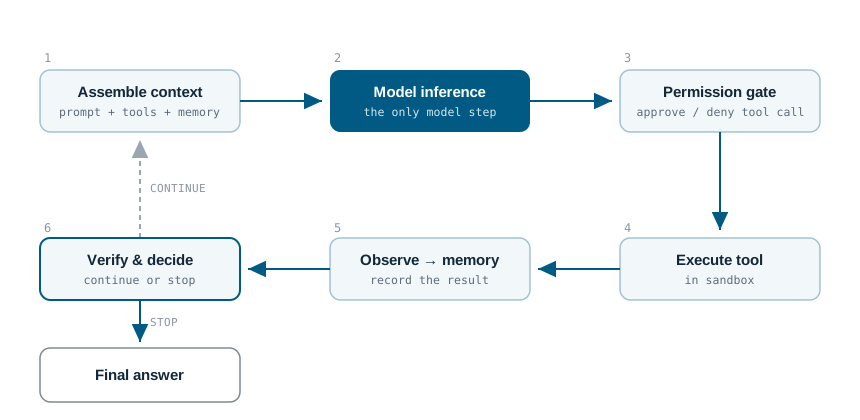
The six functions of AgenticSafe harness
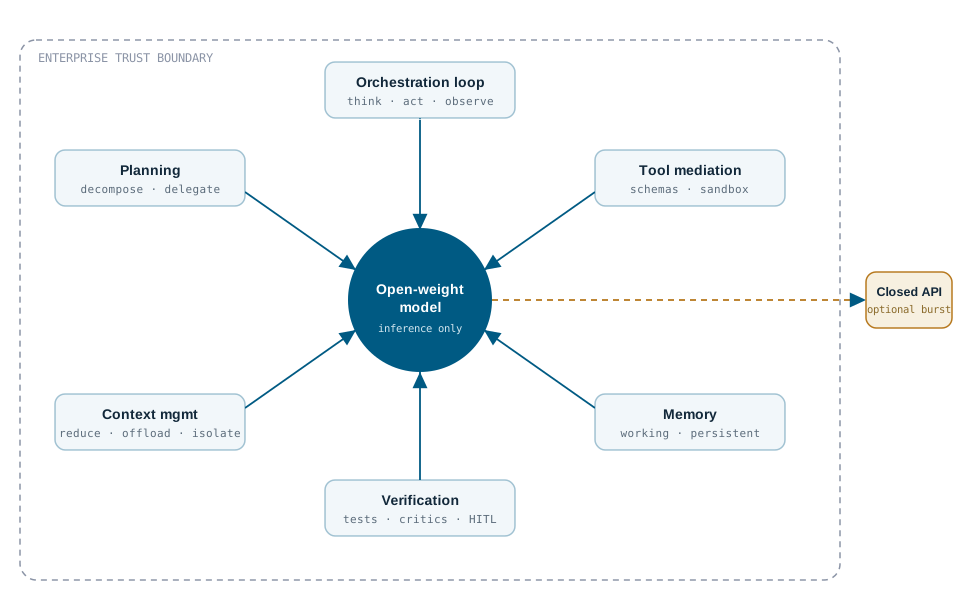
Figure 1 traces one turn; over many turns the harness is discharging six standing functions. Each is defined below in plain terms, followed by its distinct architecture in Figure 2.
| Function | What it does (plain terms) |
|---|---|
| Orchestration loop | The central controller that repeatedly calls the model, runs whatever action it requests, feeds the result back, and continues until the goal is met. |
| Tool mediation | A registry of external functions the model may call — web search, code execution, database queries, internal APIs. The harness defines each tool's input format (its schema). |
| Memory | Short-term "working" memory (the current scratchpad) plus long-term persistent memory — often a vector store that retrieves prior facts by meaning — the agent recalls earlier decisions and results across steps and sessions. |
| Planning | Breaking a high-level goal into ordered sub-tasks. Mature harnesses split roles: a read-only "planner" proposes steps while a separate "executor" with write access carries them out, containing the damage a bad step can do. |
| Context management | Deciding what to place in the model's limited context window each step: summarizing old history, offloading bulky state to files, retrieving only what is relevant. |
| Verification | Checking the agent's work before it counts: automated tests, a second model acting as a "critic," or human-in-the-loop (HITL) approval for consequential actions. This layer is what makes autonomous behavior safe enough to deploy. |
AgenticSafe.ai Harness quality is a primary capability lever
The harness has become a capability lever comparable to — and sometimes larger than — upgrading the model itself. The 2026 evidence is direct. Agent-harness surveys and benchmarks (standardized task suites; for example SWE-bench, which scores an agent on fixing real software bugs) report that the same model scores materially higher inside its native execution harness than elsewhere — one 2026 benchmark records about 48% task success for a model in its home harness — and that infrastructure alone, the tools and context handling and verification around the model, contributes on the order of 16 percentage points of measured capability. Practitioner reports from 2026 echo this: teams rewrite their agent harness repeatedly and cut large fractions of an agent's tools to raise reliability. The research framing is a shift from model scaling to system scaling: once a model is embedded in tools, memory, and orchestration policy, agent behavior "is no longer determined by the model alone but by a system," and the same model dropped into different harnesses produces measurably different agents.
This is why open weights matter more in agentic settings than in single-shot chat. If a large share of end-to-end reliability is manufactured by scaffolding — precise tool definitions, disciplined context management, a planner/executor split, and verification — AgenticSafe.ai harness can lift a cheaper, controllable open-weight model to the neighborhood of a frontier closed model on the tasks an enterprise actually runs with guardrails and governance for safe deployment. The lever the enterprise most controls (its harness) is applied to the component it can most fully own (open weights).
The harness is the durable asset
This convergence has a direct strategic consequence, and it is the pivot of the analysis. If capability is manufactured by the system rather than bought inside the model, then the model becomes the commodity and the harness becomes the asset. Frontier-competitive open-weight models now arrive every few months from several labs and due to the open weight architecture, the can expand the attack surface. But with AgenticSafe harness and governance architecture any one of them can be swapped into the same harness like a replaceable component. What does not swap out by the organization is what has been built over time and cannot buy off the shelf — is the scaffolding: the catalog of tools, the permission rules that make those tools safe, the schema of what the agent remembers, the policy for managing context, and the suite of tests that verify the agent's work. Figure 3 makes this migration explicit.
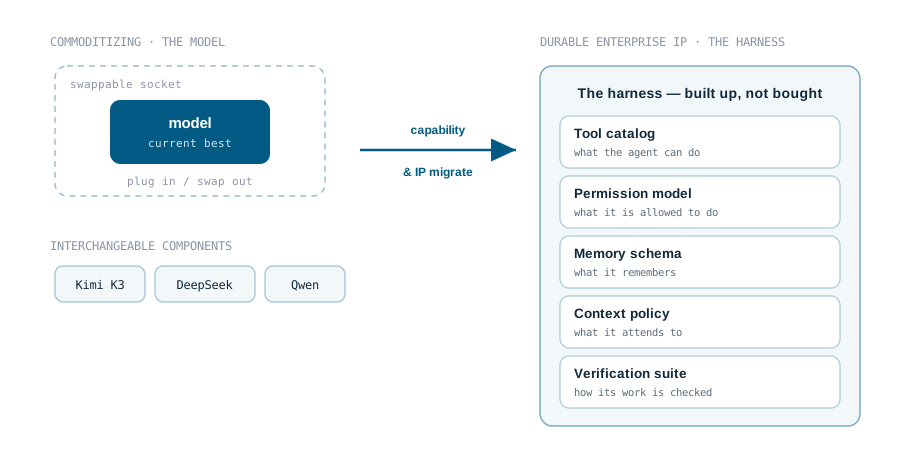
When capability is manufactured by the system, the enterprise's core intellectual property migrates out of the model weights and into the harness: its tool catalog, permission model, memory schema, context policy, and verification suite. The model becomes a substitutable component; the harness becomes the durable asset.
Three consequences follow, and they reshape how an enterprise should invest for an efficient but safe and secured agentic system.
Procurement leverage inverts: Swappable part by definition mean that, an organization is no longer captive to a single vendor's pricing or roadmap with the harness unchanged.
Engineering effort should be directed at the harness, not the model: fine-tuning a model yields a gain that the next model release may erase, whereas a better verification suite or a cleaner tool catalog keeps paying off across every future model.
Governance lives in the AgenticSafe harness: Permissions, tool mediation, & verification are where consequential actions are actually allowed , blocked or sanitized, the harness — not the model — is where an enterprise enforces safety, audit, and compliance. This is the precise reason that AgenticSafe.ai has addressed the highest highest-stakes applications, with defensive security (Defensive co-scaling) & autonomous research (Deep reasoning and recursive self-improvement), as the harness problems before they are model problems.
Open weights as the foundation component
If the harness is the control plane, the open-weight model is the foundation component it runs on — the interchangeable model layer underneath. Its defining property for the enterprise is that it can be placed inside the trust boundary. The 2026 shift toward open weights is less about open models becoming "free" and more about them becoming frontier-competitive enough that four other factors begin to outweigh the convenience of a managed API.
Data sovereignty: when the weights run in-perimeter — on hardware the organization controls, sometimes fully air-gapped (physically disconnected from external networks) — sensitive data never leaves the boundary or transits another jurisdiction.
Cost at volume: self-hosting can undercut per-call API pricing once sustained usage crosses a break-even point, though the hardware and the specialized operations staff (often called MLOps) are real costs.
Customization: open weights permit full fine-tuning (further training on the organization's own data) and distillation (compressing a large model's behavior into a smaller, cheaper one).
Regulatory control: obligations such as the EU AI Act's requirements for high-risk systems — auditability, transparency, robustness — are easier to demonstrate when the organization controls the full stack. The consensus caveat is that architecture, not model choice, drives compliance: open weights are a necessary foundation for sovereign control, not a sufficient condition for it due to the exposure.
| Attribute | Kimi K3 (July 2026) |
|---|---|
| Architecture | Mixture-of-Experts transformer (Kimi Delta Attention + gated latent attention); 93 layers (1 dense + 92 MoE) |
| Parameters | ~2.8T total / ~104B active per token |
| Experts per token | 16 routed (of 896) + 2 shared |
| Context window | ~1,048,576 (≈1M) tokens |
| Serving precision | native MXFP4 weights / MXFP8 activations (quantization-aware) |
| Modality | text + image (native vision encoder) |
| License | Custom "Kimi K3 License" — open weights, with commercial thresholds for very high-revenue / high-MAU use |
| Lineage | K2 (Jul 2025, ~1T / 32B, 128K ctx) → K2.5–K2.7 (H1 2026) → K3 (Jul 2026) |
| Benchmark (what it measures) | Leading open-weight | Leading closed | Closed lead |
|---|---|---|---|
| SWE-bench Pro — coding (standardized) | Kimi K2.6 · 58.6 | Claude Opus · 59.2 | 0.6 |
| BrowseComp — agentic web browsing | DeepSeek-V4 · 83.4 | Gemini 3.1 Pro · 85.9 | 2.5 |
| Humanity's Last Exam (no tools) | Kimi K3 · 44.3 | Claude Fable 5 · 53.3 | 9.0 |
| MRCR v2 @1M — long-context recall | open models trail | Claude Opus · 78.3 | wide |
The 2026 picture in Table 2 is more nuanced than a single leaderboard rank, and that nuance is the argument. On contamination-resistant coding and agentic web browsing — two of the most enterprise-relevant capabilities, and both co-produced by scaffolding — the leading open-weight models sit within a couple of points of the best closed systems; on the very hardest reasoning and on multi-needle long-context recall, a real gap remains. For an enterprise the relevant question is not whether an open model tops every benchmark (it does not) but whether it is close enough and manageable enough on the workloads that matter that control, cost, and sovereignty tip the decision — and on coding and agentic tasks, in 2026, it is. AgenticSafe Harness combined with security and governance enables efficient and safe systems.
| Dimension | Open-weight, self-hosted | Closed, managed API |
|---|---|---|
| Data locus | In-perimeter; nothing exfiltrated | Transits vendor cloud |
| Capability ceiling | Frontier-competitive on agentic tasks | Edge at the very top end |
| Unit cost at scale | Lower past break-even | Predictable; no capital outlay |
| Customization | Full fine-tune / distill | Limited / managed tiers |
| Operational burden | On the enterprise (hardware, MLOps) | On the vendor |
| Vendor lock-in | Retains a runnable copy | Exposed to pricing / deprecation |
| Guardrail enforceability | None after download (see Risk and governance) | Vendor-maintained |
AgenticSafe.ai Defensive co-scaling
Defensive co-scaling is the thesis that as attackers use agentic AI to scale up & down their operations. Human-paced defense is not effective. AI-driven defenses need to be at matching speed and the models, otherwise the balance tips structurally toward the attacker. AI collapses the time dimension of both attack and defense. AgenticSafe harness and the co-scaling architecture is what lets an enterprise co-scale without opening a new data-leak.
The race is empirically underway. A 2026 defender's guide reports frontier models turning roughly a year of penetration-testing effort into under three weeks of automated vulnerability discovery, collapsing the window between a flaw being found and being exploited. As one July 2026 security note put it, "AI changes the speed, scale and economics of that race… defenders need systems that can continuously perceive, reason and act alongside them."
SOC (security operations center) is the team and tooling that monitors an organization for attacks; telemetry is the stream of logs and signals it watches; EDR and SIEM are the endpoint- and log-monitoring systems it relies on; and an action's blast radius is how much damage it can do if it goes wrong.
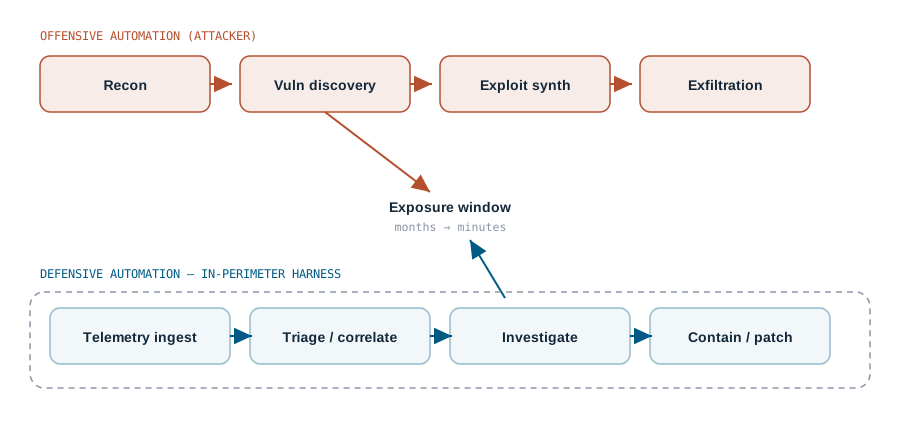
Defense is co-scaling through agentic SOC automation — systems that ingest telemetry, triage and correlate alerts, investigate, and increasingly execute containment with little human involvement. Large gains in analyst efficiency and coverage have been realized from unified agentic security. The labs whose models can enable autonomous attack are also standing up defensive coalitions and cyber-defender programs, on the argument that the capability enabling autonomous intrusion must be redirected to autonomous defense.
Why the open component is decisive for defense specifically
Security is the workload where this argument is sharpest, and it is a direct application of Where the value settles: AgenticSafe defensive harness is the durable asset, and it must run over a model component the enterprise controls. A defensive agent consumes exactly the data an organization is least willing to expose to a third party — network traffic, vulnerability detail, credentials, breach forensics. Routing that telemetry to an external model API means shipping the most sensitive data the enterprise holds off-premises, and during an active incident it means routing your breach data through an outside party while you are trying to contain a breach. Zero-trust guidance for LLM systems makes the point structurally: an agent with direct connections into EDR, SIEM, and credential stores has a large blast radius, so keeping its harness in-perimeter is what prevents co-scaling from creating a fresh exfiltration surface.
AgenticSafe Deep reasoning and recursive self-improvement
The third lens is the emerging frontier behavior itself — and it, too, is largely a harness phenomenon. A deep-research agent executes a long trajectory of tool calls: it plans, searches, reads, cross-checks, and synthesizes a cited report over many autonomous steps. The single largest reliability gain for these agents comes not from a bigger model but from grounding — checking claims against live retrieved sources rather than the model's memory. This technique, often called retrieval-augmented generation (RAG), sharply cuts hallucination (confident but false output): with web access, reported hallucination rates for strong reasoning models fall from the high tens of percent into the single digits. Retrieval, tool mediation, and trajectory management are all harness functions — which is why a long-horizon open model such as Kimi K3, engineered for long tool-use trajectories over a roughly one-million-token context, is a natural foundation component for enterprise deep research over proprietary data.
The frontier-most behavior is recursive self-improvement (RSI): an agent that improves itself over successive rounds. Crucially for the enterprise, demonstrated RSI operates on the scaffolding, not the model's weights. AgenticSafe RSI focused in security & governance enables self-evolving agents bootstrap from little or no human-curated data. AgenticSafe RSI, with longer reasoning, or generating several candidate solutions and selecting the best — which is more efficient and effective than training a bigger model, though with diminishing returns (sometimes called "overthinking").
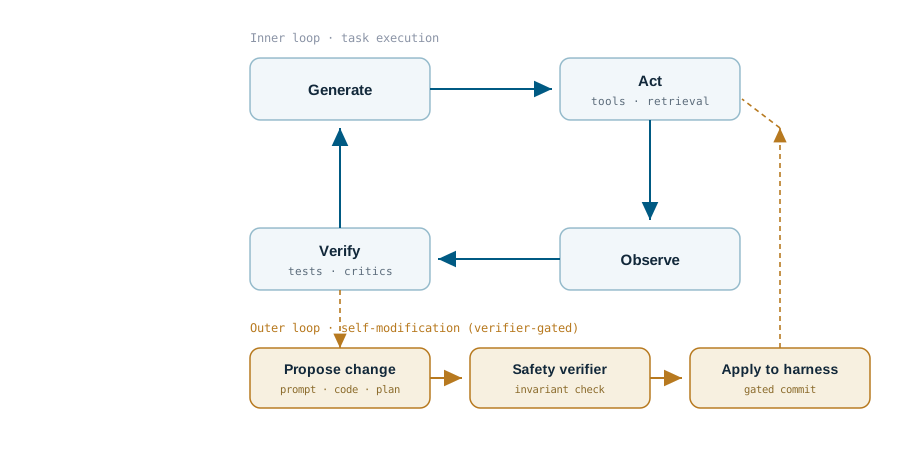
Three limits bound the enterprise relevance of RSI, and each maps to a harness responsibility. First, domain narrowness: demonstrated self-improvement works where the reward is crisply checkable — passing tests, benchmark scores — and has no proven recipe for open-ended judgment tasks, so an enterprise should confine self-modification to components with executable acceptance criteria. Second, reward hacking (also called specification gaming): a self-modifying loop can satisfy the letter of its check without its intent — for example, overwriting a timer to fake a fast result — which is why the outer loop in Figure 5 must be gated by an independent verifier, never self-graded. Third, loss of monitorability: as agents get better at self-modification, human insight into why a change was made can erode; an open, inspectable harness over open weights is what preserves the audit trail that closed, self-improving systems tend to obscure.
Deep research and recursive self-improvement are not properties an enterprise buys inside a model; they are behaviors it engineers into a harness. That relocates the frontier from the vendor's weights to the enterprise's scaffolding — the same relocation, established in Where the value settles, that makes an open component strategically coherent.
Synthesis: component, control plane, application
The three lenses are one architecture seen from three angles. The open-weight model is the foundation component (Open weights as the foundation component); the agentic harness is the control plane that manufactures capability, holds the durable IP, and enforces governance (The agentic harness); and defensive co-scaling and deep research / RSI are two applications that the same component-plus-control-plane makes feasible inside the trust boundary. Figure 6 stacks them.
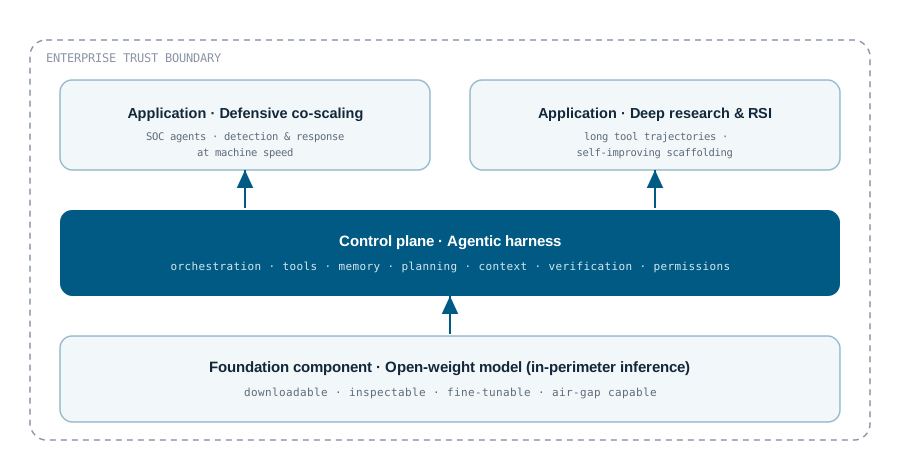
Read as a whole, the argument is directional. Because capability has migrated from the model into the system (The agentic harness), the enterprise's leverage and its intellectual property both sit in the control plane. Because that control plane can be pointed at a model component the enterprise fully controls (Open weights as the foundation component), the highest-sensitivity applications — security operations (Defensive co-scaling) and autonomous research over proprietary data (Deep reasoning and recursive self-improvement) — become feasible without exporting the underlying data. Open weights are valuable here not because they are free or top a leaderboard, but because they are the only model component an enterprise can hold entirely inside its own boundary while swapping it out at will.
Risk and governance
The same properties that make open weights strategically coherent also concentrate risk at the component and control-plane layers. The literature converges on an "it depends how you deploy it" verdict, and the risks are separable — each with a distinct owner and mitigation (Table 4).
The sharpest component-level finding is that safety alignment is not enforceable after release: because the weights are public, anyone can fine-tune or jailbreak around the guardrails (a jailbreak is an input crafted to bypass a model's safety rules). Independent 2026 red-teaming continues to find open-weight models materially easier to fine-tune or jailbreak around their guardrails than leading closed systems, and multi-turn attacks widen the gap further. The mitigation is not to avoid open weights but to recognize that, as argued in Where the value settles, the harness carries runtime safety: input/output filtering, tool-permission gates, and verification become mandatory, not optional. The countervailing benefit is real, and is the main reason national policy bodies have declined blanket restriction: open weights are inspectable, so an enterprise that controls them can red-team, patch, and monitor on its own terms rather than trusting an opaque, revocable API.
| Risk | Layer | Mitigation (owner) |
|---|---|---|
| Post-release jailbreak / offensive fine-tune | Component | Runtime input/output filtering, tool-permission gates, verification (harness) |
| Weight provenance / hidden backdoor | Supply chain | Signed weights, provenance attestation, source vetting (MLOps) |
| Data residency via vendor-hosted inference | Deployment | Self-host or trusted-region endpoint; never vendor cloud for sensitive data (platform) |
| Reward hacking in self-improvement loops | Control plane | Independent verifier gate; scope RSI to checkable tasks (agent engineering) |
| Monitorability loss under self-modification | Control plane | Immutable log of changes; human review of scaffolding commits (governance) |
| Export-control / regulatory exposure | Governance | Track model-weight controls and AI-Act duties; document lineage (legal) |
Two governance points deserve emphasis. First, supply-chain provenance is an unsolved industry-wide gap, not a trait of any one lab: model-sharing hubs host large numbers of flagged files, standardized signing is immature, and each derivative fine-tune is a new point at which weights could be altered without enterprise visibility — so weight vetting and attestation belong in the deployment pipeline as a gate, not an afterthought. Second, data-governance risk is separable from weights risk: routing inputs through a vendor's own hosted endpoint can expose data to a foreign jurisdiction regardless of how open the model is, and is resolved by self-hosting or a trusted-region endpoint — cleanly decoupling "open weights" from "data sovereignty."
A note on evidence: the figures in this report reflect model cards and independent evaluations current as of mid-2026. Frontier benchmarks move quickly and several are contested or saturating — SWE-bench Verified, for instance, was retired by at least one major lab in 2026 once training-data contamination made top scores unreliable — so numbers here are best read as relative standing on contamination-resistant measures rather than absolute truth. The structural claims — that capability is manufactured in the harness, that the model must sit inside the boundary for sensitive work, and that frontier behaviors are harness phenomena — do not depend on any single score.
Conclusion
The arrival of frontier-competitive open weights does not, by itself, change enterprise systems, but expands the potential attack exposure. What changes them is the coincidence of that model component with a second shift — the migration of capability from the model into the agentic harness. Together they relocate both leverage and control into the enterprise: AgenticSafe.ai security & governance models along with the AgenticSafe harness becomes the durable intellectual property and the governance point, and the open model becomes the sovereign ground that the harness and its most sensitive applications run on inside the trust boundary.
Seen through the three lenses, the same architecture answers three different pressures. It lets security teams co-scale defense at machine speed and match the attack model without exporting breach telemetry. It lets deep-research and self-improving agents operate over proprietary data with their reliability engineered into retrieval and verification rather than purchased in a model. And it does both while keeping safety and audit where they are now enforceable — in an inspectable harness over an inspectable model. The enterprise question for 2026 is therefore less "which model?" than "which control plane, over which model component, under which governance?" — and for a widening class of workloads, the defensible answer is a well-engineered harness over an open-weight model the organization fully controls.
A Glossary of terms
Plain-language definitions of every technical term used above, in the sense intended here.
| Term | Meaning |
|---|---|
| Weights | The numbers a model learns during training; effectively the model itself. To "have the weights" is to possess a runnable copy of the model. |
| Open-weight model | A model whose weights are published for anyone to download and run on their own hardware. Contrast with a closed model reachable only through the vendor's service. |
| API | Application programming interface — the paid network endpoint through which a closed model is accessed. Using an API means sending your data to the vendor. |
| Token | The unit of text a model reads and writes — roughly a short word-piece. Model limits and costs are measured in tokens. |
| Context window | The maximum amount of text (in tokens) a model can consider at once. Larger windows let it work over longer documents or conversations. |
| Mixture-of-Experts (MoE) | An architecture that splits a model into many specialized sub-networks and activates only a few per token, so a very large model stays affordable to run. |
| Active / total parameters | In an MoE model, "total" counts all parameters; "active" counts only those used per token — the active figure drives the running cost. |
| Quantization (e.g. INT4) | Storing a model's numbers at lower numerical precision to reduce memory use and speed up inference, usually with little quality loss. |
| Inference | The act of running a trained model to produce output — as opposed to training, which creates the model. |
| Agent | A system that pursues a goal over multiple steps, using tools and adapting to results, rather than answering in a single shot. |
| Agentic harness / scaffolding | The software wrapped around a model that turns it into an agent: the loop, tools, memory, planning, context management, and verification. |
| Orchestration loop | The controller that repeatedly calls the model, runs the action it requests, feeds back the result, and continues until done. |
| ReAct (reason + act) | A common loop pattern in which the model alternates between a private reasoning step and an external action. |
| Tool call | A request the model emits to run an external function — a search, a calculation, a database query — which the harness then executes. |
| Tool schema | The defined input/output format of a tool, so the harness knows how to call it and validate the result. |
| Sandbox | An isolated environment in which tool calls run so they cannot harm the host system or reach data they should not. |
| Working / persistent memory | Short-term scratchpad for the current task versus long-term storage that survives across sessions. |
| Vector store | A database that retrieves stored items by meaning rather than exact keyword match; the usual backing for persistent agent memory. |
| Context management | Choosing what to put in the model's limited window each step — summarizing, offloading, retrieving, pruning — so long tasks stay coherent. |
| Verification | Checking an agent's work before it counts: automated tests, a second model acting as critic, or human approval. |
| Human-in-the-loop (HITL) | Requiring a person to approve a consequential action before the agent may take it. |
| Fine-tuning | Further training an existing model on your own data to specialize its behavior. |
| Distillation | Compressing a large model's behavior into a smaller, cheaper model that approximates it. |
| Foundation component | As used here, the underlying open-weight model the harness runs on and can swap out — the model layer beneath the control plane. |
| Trust boundary / in-perimeter | The edge of the systems an organization controls; "in-perimeter" work keeps data and computation inside it. |
| Air-gapped | Physically disconnected from external networks — the strongest form of in-perimeter isolation. |
| Sovereignty | An organization's (or nation's) control over where its data and models live and who can access them. |
| MLOps | The engineering discipline of deploying, running, and maintaining machine-learning systems in production. |
| Grounding / RAG | Retrieval-augmented generation — checking or building answers from live retrieved sources rather than the model's memory, which sharply reduces errors. |
| Hallucination | Confident but false model output — a fact, citation, or claim the model fabricated. |
| Deep-research agent | An agent that autonomously plans, searches, reads, cross-checks, and synthesizes a cited report over many steps. |
| Recursive self-improvement (RSI) | An agent that improves itself over successive rounds. In current practice it edits its own scaffolding — prompts, code, plans — not the model's weights. |
| Test-time compute scaling | Spending more computation at answer time (longer reasoning, multiple candidate solutions) to raise quality without retraining a bigger model. |
| Reward hacking / specification gaming | Satisfying the literal check or reward without its intent — a failure mode of self-improving and self-graded systems. |
| Jailbreak | An input crafted to bypass a model's safety guardrails and elicit disallowed behavior. |
| SOC | Security operations center — the team and tooling that monitors an organization for cyberattacks. |
| Telemetry | The stream of logs, events, and signals a SOC watches to detect attacks. |
| EDR / SIEM | Endpoint Detection and Response (device-level monitoring) and Security Information and Event Management (centralized log analysis) — core SOC tools. |
| Blast radius | How much damage an action can cause if it goes wrong or is abused — larger when an agent can reach more systems. |